
Creating Value for Online Shoppers
In today’s digital era, more and more people are shifting their shopping habits from traditional brick-and-mortar stores to online retailers. While this trend is not new, the COVID-19 pandemic significantly accelerated the adoption of online shopping beyond expectations. In Turkey, mobile shopping has now become the primary way people make purchases.
Online shopping presents many opportunities to meet customer expectations and address unmet needs. Even more than in physical stores, customers are highly conscious of how and where they spend their time and money. As a result, they often spend hours deciding which products to buy, when to buy them, and where to make the purchase. The heavy focus on price comparisons and promotions can make this process overwhelming, leaving shoppers stressed and frustrated.
Fortunately, there is an opportunity to improve this experience.
Product Vision
Imagine a shopping app that allows users to save products they love and are considering purchasing. The app tracks price drops and stock availability in real time and even rewards users with cash back when they complete a purchase through the platform.
By centralizing these features in one place, the app simplifies the decision-making process and removes much of the friction associated with online shopping. Shoppers can confidently decide when and where to buy, knowing they are saving both time and money.
Ultimately, the goal is to create an effortless shopping experience that helps users easily discover, track, and purchase the products they love at the best possible prices. Acting as a trusted companion, the app reduces shopping-related stress and alleviates decision fatigue.
The problem
In Turkey, shoppers—particularly millennials—are becoming increasingly price-conscious. The days of walking into a store and purchasing a product directly from the shelves are fading. Instead, today’s shoppers take on the burden of independently researching multiple retailers to find the best possible price.
They spend valuable time comparing prices, searching for promo codes and coupons, and determining the optimal moment to make a purchase based on the information they gather. Yet, despite this added effort, many shoppers still experience hesitation and uncertainty at the point of purchase, leading to decision fatigue and delayed buying.
Outcome
A mobile app was developed to serve as a bridge between customers and retailers. It enables online shoppers to purchase products at the most appropriate time and at competitive prices, reducing hesitation and uncertainty during the buying process.
At the same time, the app increases retailers’ appeal by offering customers cashback rewards, creating a mutually beneficial experience for both sides. Through this mobile app, we are gathering early user feedback to build strong business cases and identify opportunities for future growth.
User Goals
Business Goals

Process Highlights
Service Name
The product team consisted of a UX designer, a product manager, and three engineers.
Methodology
Qualitative and quantitative user research, wireframing, prototyping, user flows, and user testing.
Resposibility
UX designer
Project Plan:
Three weeks of research and ideation followed by rapid prototyping and production.

Research
Primary and secondary research were conducted to identify online shoppers’ most significant pain points and unmet needs. Since the client had already formed initial assumptions, our role focused on exploring and validating these assumptions through research.
Our research methods included market analysis, questionnaires, semi-structured interviews, and field observations. These activities enabled us to clearly define the target audience and uncover key frustrations within the online shopping experience, ultimately informing a well-supported product hypothesis.
Market Research
Market research was conducted to determine and better understand the target market, their needs, and their desires in connection with an online shopping app.
takeaways from the research were as follows:
Online shoppers
younger than 34
61% of mobile commerce was completed via in-app purchases in 2020.
-
Mobile commerce in Turkey is predominantly app-based, with shoppers preferring mobile apps over web browsers.
-
Online shoppers are more price-sensitive than in-store shoppers and are more likely to change their purchase decisions due to price fluctuations.
-
For Turkish online shoppers, reasonable prices, time savings, and product availability and variety are the primary motivations for shopping online.
-
Among these factors, competitive pricing stands out as the most influential driver of online purchasing behavior.
-
To improve the online shopping experience, Turkish e-commerce managers should prioritize security, clearer site organization, and compelling shopping deals.


66.9 percent of web shopping was done via mobile apps in Turkey.
Primary Research
Target Audience
Based on secondary research, the client identified two distinct user groups to target. To validate that the identified problem existed within each group—and to uncover any additional unmet needs—both qualitative and quantitative research methods were conducted.
Questionnaires:
We used an online questionnaire to understand the shopping behaviors of different user groups and to identify participants who best represented these groups for follow-up interviews. The survey achieved an 82% response rate, with 122 completed questionnaires included in the analysis. Participants completed the questionnaire via an online survey platform.
Data collected through the questionnaire included:
-
Demographic information
-
Preferred shopping channels
-
Types of purchases
-
Amount spent per purchase
-
Shopping frequency
-
Factors influencing shopping decisions
-
Problems encountered during shopping
-
Information sources used during decision-making
-
Repeat purchase behavior
-
Online shopping experiences
-
Price sensitivity
-
Product categories
Interviews:
Eight in-depth interviews were conducted with participants from each user group to gain deeper insights into users’ pain points, challenges, and opportunities for improving the online shopping experience.
User groups:
-
Millennials: Goal-oriented, time-sensitive, online shoppers, price-sensitive
-
Gen Z: Price-sensitive, online shoppers
Following the interviews, field observations were conducted to validate whether participants’ stated behaviors aligned with their real-life shopping practices. During these sessions, users were asked to think aloud, allowing us to gain deeper insight into their decision-making processes, behaviors, and pain points.
Six participants shopped using their smartphones, while one preferred a desktop experience. Notably, none of the users completed a purchase during the observation sessions, highlighting existing friction and hesitation within the shopping journey.

After completing the interviews and field research, an affinity map was created to group together interviewees answers into themes to help find the main problems that needed to be solved.

Personas
Based on the research, Personas, each representing a target user group, were created so that all team members were aligned regarding whom we were targeting and why.


Customer Journay Map
After the research was completed, a customer journey map was created to visually lay out the target groups' touchpoints, pain points, and to find possible solutions to improve their experience. A hybrid approach to journey mapping was used. Initially, a journey map was created based on assumptions with an updated map to follow based on the primary research.

Iteration
Based on the research findings and business objectives, a thesis hypothesis was defined. Engineers and stakeholders then collaborated to evaluate potential opportunities and determine which initiatives to pursue, taking time, cost, and quality constraints into account.
To maximize impact while minimizing technical complexity, features requiring the least engineering effort with the highest user value were prioritized for the initial product release. Research clearly indicated that Turkish online shoppers are mobile-first, with most target users relying on smartphones to research and purchase products.
As a result, a mobile app was selected as the primary delivery channel. The app was designed to offer the following services:
-
Price notifications
-
Stock notifications
-
Product saving
-
Cash-back rewards
.jpg)
Second round of research
Interviews
second round of primary user research was conducted prior to the prototyping phase to evaluate how the target audience would respond to the cashback service. An online questionnaire was distributed to 162 participants who matched the target demographics.
In parallel, interviews were conducted with representatives from four major online marketplaces and six online retailers to better understand their existing marketing initiatives and assess their willingness to adopt cashback as part of their digital marketing strategies.
The research aimed to answer the following questions:
-
Which product categories do users most frequently purchase online?
-
What level of cashback do users expect?
-
How likely are users to make a purchase from a new cashback-based online store?
-
How likely are users to return to an online store offering cashback?


Would use a cashback service.
Likely to use cashback online store
Competitive Analysis

Prototyping
Following the iteration phase, user flows were created for the highest-impact feature sets. These were validated early through paper sketches and mock-ups. Based on feedback, the designs were iterated and developed into mid-fidelity wireframes and a low-fidelity prototype.
Finally, an interactive product prototype was built and used during usability testing sessions to validate the overall experience and key interactions.


Validation
Ten usability testing sessions were conducted remotely via Userberry, an online usability testing tool. Great importance was placed on recruitment to ensure the product was being tested with the right users. A pilot test was performed to ensure everything would run smoothly during the actual test sessions.
The product was tested as a whole; then, specific features were validated. Users were asked to verbalize their thoughts as they moved through the user interface to attain a deeper understanding of how users felt about the product and what needed improvement.
Users were assigned situational tasks, and we observed their behavior. They were asked to externalize their thoughts for us to comprehend better how they felt about the product.

Usability test plan

Upd

Prototype revision
After completing usability testing, an affinity map was created to identify patterns and recurring themes observed during the sessions. Task success rates, failure rates, and completion times were measured, and the prototype was iteratively updated based on insights gathered during the validation sessions.


Although a mobile app was selected as the primary touchpoint for delivering the service, validation testing revealed that mobile push and email notifications were equally critical to the overall experience. Based on this insight, an email notification strategy was developed to inform users about price changes, stock availability, and cashback availability, ensuring timely and relevant engagement beyond the app itself.

Outcomes
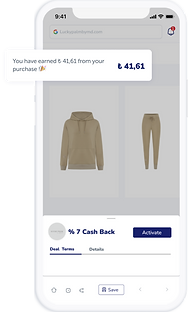
In September 2022, a mobile app, website, and Chrome extension were launched with 24 cashback-enabled online stores. Within a short period, the platform reached over 100,000 users. The mobile app and Chrome extension were designed to work interchangeably, allowing users to seamlessly track prices, receive cashback, and shop across devices.
In 2025, the application was discontinued due to business-related challenges, primarily around monetization. Despite its closure, the product successfully validated strong user interest and demand for cashback-driven, price-conscious shopping experiences.

